lexisOS
Setting things up…
Setting things up…
Loading features…
A single builder produces either a standalone form or a full landing page with a form embedded directly inside it — 11 field types, conditional show/hide logic, and A/B-tested variants. Publish to a hosted URL, a short link, or your own custom domain.
A Forms object is either a form or a landing page — same builder, same publishing flow. Forms render from 11 field types, from plain text and email to dropdowns, checkboxes, and multi-select, with conditional logic that shows or hides a field based on an earlier answer. A landing page composes hero, features, testimonials, CTA, FAQ, image, and video blocks — and a form drops in directly as one of those blocks, so the page and the form it captures leads with are one object, not a link between two separate tools.
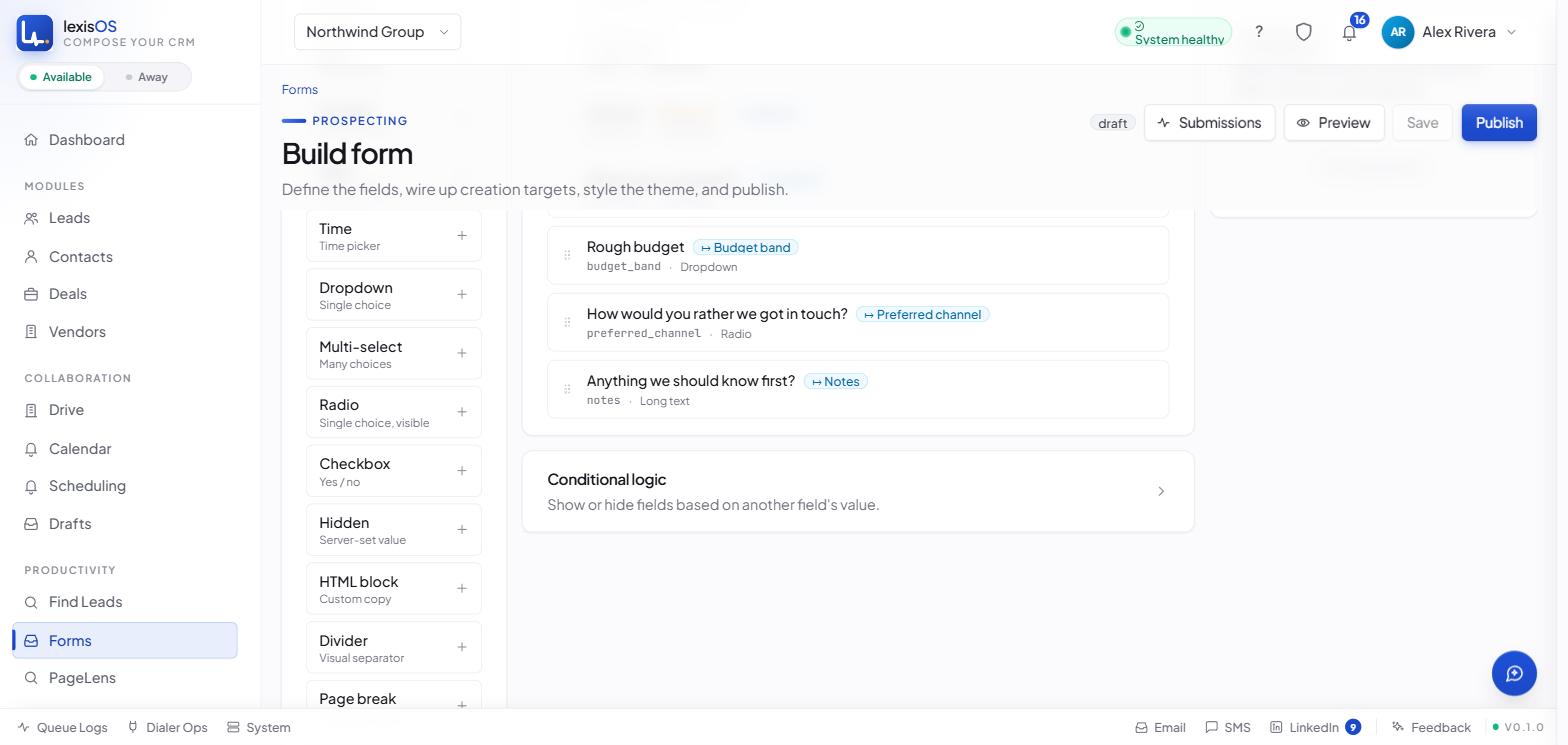
Add fields or blocks, set conditional logic, and preview as you go.
Get a hosted URL or a short link the moment you publish.
Add a CNAME and a TXT record; DNS is checked automatically until it verifies, and TLS is provisioned once it does.
The published form or page is live on whichever URL you chose.
The base builder covers fields, logic, and publishing. These are separate switches on top of it.
Weighted, sticky traffic splits across variants, with per-variant view, start, and submission analytics.
Point your own domain at a form — DNS verification and TLS renewal run automatically in the background.
A returning visitor, recognized by a visitor cookie, sees fewer fields the second time around.
Take LexisOS’s mark off the public page for a fully white-labeled form.
An invisible honeypot field and a per-IP rate tracker feed a spam score; anything at or above the threshold is dropped silently, with the submitter never told. What gets through can be routed by conditional rules to the right owner, split across a round-robin pool of teammates, and answered automatically by a per-form autoresponder — while an owner-notification email, an HMAC-signed webhook, and a Slack webhook (restricted to a real hooks.slack.com address) all fire in parallel. A submission can also enrich itself automatically before it reaches a rep — a people search, a business search, or an email verification, depending on what the form captured — its own separate switch, on top of the base builder.
A visitor fills out the form or page.
An invisible field and a per-IP tracker run before anything else.
A submission scoring at or above the threshold is dropped silently.
What passes goes to an owner, a round-robin pool, and any configured webhooks.
Start free and publish your first form to a hosted URL. Add a custom domain, A/B testing, or progressive profiling whenever you’re ready.